This page is my dedicated portfolio website for my application to the M.S. program at UCSB's MAT department. In it you will find some of my selected compositions, as well as documentation of some of my work in Max/MSP.
Squelch, fixed audio:
In composing this piece, I wanted to focus on the juxtaposition of aesthetics; the timing goes between rhythmic and sporadic, the textures between dense and bare, the sound design shifts between harsh noise and ambient pads. Much of my work utilizes dissonance, noise, and aesthetic juxtapositions like these to reflect the constant discomfort behind my experiences living with a chronic disability.
Sleep Study II, fixed audio:
Sleep Study II was my attempt at making something misleading; two different ambient drones juxtaposed with a collage of whatever I could think of. This is the first piece that I made in Ableton, and I think it's a bit apparent that it was made in Ableton in some moments, but I tried hard to make it stand out as its own sound. I was really influenced by hyperpop and PC music while working on this, but I think it ended up being far removed from those aesthetics. Many of the sounds present in the chaotic collage in the middle come from different experiments in Max, especially with different feedback systems built in the gen~ environment.
Crawling on Elbows, live processed vocals:
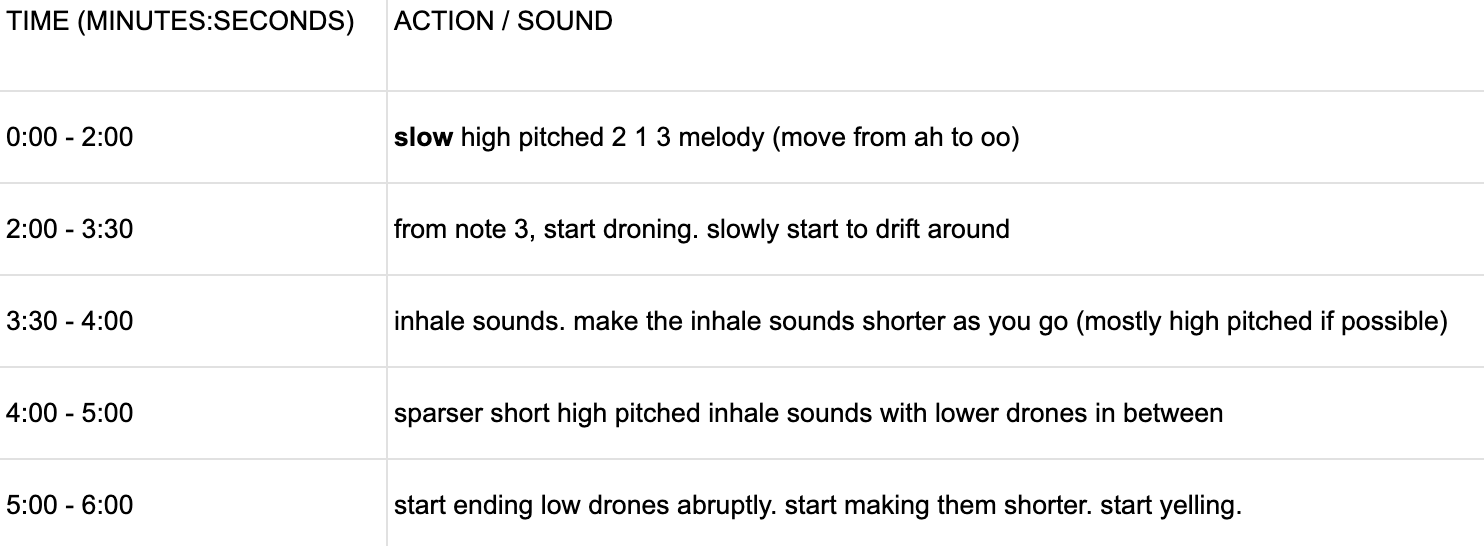
When I started working on Crawling on Elbows, I was faced with a problem: I felt like I needed another piece for my junior recital, and I had been working on something using a game controller interface, but I felt like it might be uninteresting for audience members to just see me barely moving my fingers. This may have been an issue that could be solved by changing the mapping and adding more planned choreography, but I also felt like it wouldn't fit to just have one piece using the controller. Because of this, I tried to think of ways that the voice could be used as a control interface beyond the typical straightforward pitch or envelope following. I came up with a system for control that uses nested envelope following, in an attempt to separate the envelopes of a phrase from the envelopes of the words or syllables contained within it; from there, you could derive information about the amounts of syllabic envelopes within each phrasal envelopes, or the average lengths of either envelope, etc. etc. etc. I then created a ping-pong delay feedback system, attempting to make something that would increase the delay time by integer multiples depending on the amount of syllables in a phrase, thinking that this would result in a subharmonic series of pitches. Instead, the system ended up being extremely chaotic, sometimes giving harmonics or subharmonics of the input, sometimes reversing the input, and occasionally giving aliasing or ring modulation of the input (I don't entirely understand what's going on when it does that). I created a basic score or guide for myself in Google Sheets for performances lasting roughly 5-8 minutes, including singing, inhale screeching, and yelling. This recording is from the premiere of the piece at an Electrophonics concert at Oberlin, OH, on November 2, 2023. You can download the max patch for the piece here.
REAL PUBLIC MELTDOWN 1
In the series that this piece comes from, REAL PUBLIC MELTDOWN, I take found footage from the internet of people who are in extreme states of dismay and add a score. As someone who has experienced panic attacks before, the idea of footage of me acting strangely going viral on the internet has been a fear of mine for a while. I explore this fear in the series, though I also try to use my scores to highlight how over-the-top the reactions of the videos' subjects are (I've found that almost every time that I panic, I'm blowing things out of proportion). In this example, a professor rants at his class after becoming upset at a student yawning. Outside of this, the score plays with tuning (each instrument using a different system) to help heighten the overall tension of the piece. The form of the score was based around finding patterns in the timing of different sections of the video.
Crawling on Elbows
The Max patch for Crawling on Elbows is linked in the Compositions section, but I'll link it here as well: https://github.com/auggggh/crawling-on-elbows
Splatter
Splatter is an additive synthesizer m4l device that I made as a final for a class on DSP. It works by having 20 oscillators tuned to multiples of a base frequency (i.e., whatever MIDI note is being fed into the synthesizer). I say "multiples" instead of "harmonics" here because you can change the ratio used to tune the oscillators. Each oscillator has its own envelope, volume, and panning; the envelopes are all simple randomized attack/decay envelopes, which can be mapped to each oscillator's individual timbre. I wrote a technical paper as part of the final, which can be read here (though I've updated it since the end of the semester that this was written), and the code can be downloaded here. I'm currently working on improving the interface for working with samples. The current system treats them as wavetables by default, forcing the user to figure out how the tuning has to be edited; I'm working on setting it up so that the user can choose between treating the sample as a wavetable or as a pitched sample, and between the sample looping or acting as a oneshot on each envelope trigger. I'd also like to add more functions to choose from to generate the mixing and panning information of the oscillators.
Collapser
Collapser is a sample-based gating distortion. When "mode" is set to 100%, this is how the effect is functioning. If mode is set to 0%, however, it will only let through samples that are quieter than the "collapse" setting, and will amplify the output by collapse's reciprical (so if collapse were at -6.02 dB, only samples below -6.02 dB (i.e., absolute value smaller than .5) would be let through, and would then be amplified by 2). You can download the code here.
Shepard Tone
Here's an implementation of the Shepard tone illusion that was based off of this tutorial from Sam Tarakajian (AKA dude837). I recreated the patch in genexpr (the text-based version of gen, the lower-level sample-based version of Max) as practice, and added a few features using the MC wrapper. To be more specific, I made it so that the amount of oscillators can quickly be adjusted, I changed the interface of the minimum and maximum frequencies to be based around a maximum frequency and the pitch distance between each oscillator, and I added individual control over the timbre and panning of each oscillator. In the future I'd like to make a M4L implementation of this, since I think it could create some interesting textures as a vocoder carrier.